This program demonstrates how to implement basic arithmeticoperations using user input in Java. The Scanner class makes it easy to read user input from the console, and the basic arithmeticoperations are performed using standard mathematical operators in Java.
Operators are symbols that perform operations on variables and values. In this tutorial, you'll learn about different types of operators in Java with the help of examples.
Operators are special symbols that perform specific operations on one, two, or three operands, and then return a result. As we explore the operators of the Java programming language, it may be helpful for you to know ahead of time which operators have the highest precedence.
Javaarithmeticoperators are used to perform basic mathematical operations such as addition, subtraction, multiplication, and division. These operators work with numeric data types like int, float, double, and long.
From simple addition and subtraction to more advanced operations like incrementing and decrementing, Javaarithmeticoperators can sometimes be tricky. In this guide, we will break down arithmeticoperators in Java with easy syntax, clear examples, and simple explanations.
The JavaArithmeticoperators include Addition, Subtraction, Multiplication, Division, and Modulus. All these ArithmeticOperators are binary, which means they operate on two operands.
Arithmeticoperators are used to perform arithmetic operations like addition, subtraction, multiplication and division. These operator performs the same operation as they perform in basic mathematics. Table below shows the list of all arithmeticoperators which you can use in your java programs.
JavaArithmeticOperators In this tutorial, you will learn about ArithmeticOperators, how many ArithmeticOperators are there in Java, what are they, and examples for these operators.
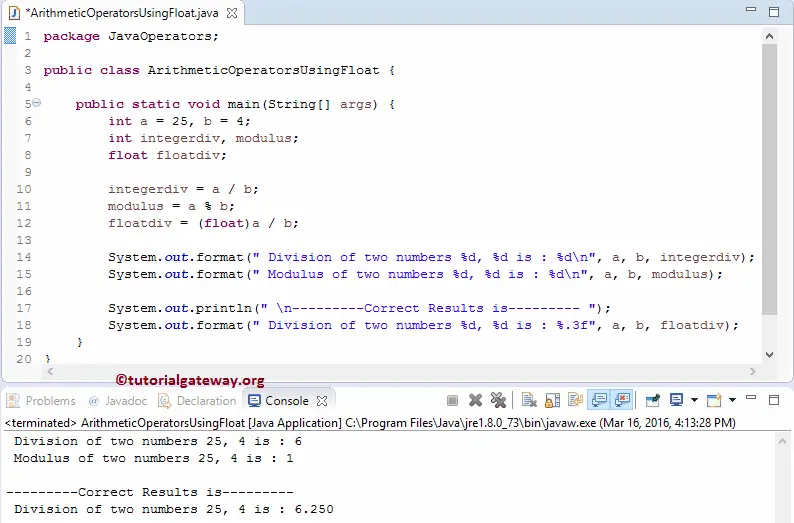 The Java Arithmetic operators include Addition, Subtraction, Multiplication, Division, and Modulus. All these Arithmetic Operators are binary, which means they operate on two operands.